Scam texts and emails relating to fines continue to circulate. We do not send payment links in our texts or emails. If you get a message about a fine and are unsure whether it is genuine, please contact our call centre on 0800 4 FINES (0800 434 637) before clicking links or making any payment. Read more about identifying scams.
Interviews were conducted between 10 February 2014 and 6 July 2014.
About the interviewers
In 2014, 26 interviewers were selected from a pool of experienced interviewers who had a proven track record working on other large government surveys. No new interviewers were used as part of the 2014 NZCASS field team.
Interviewer training
Interviewers did a range of training, including:
public sector surveying
maximising response rates
cultural awareness
enumeration
safety management and protocols for dealing with high-risk situations
the NZCASS and the questionnaire.
Victim Support also gave a presentation as part of NZCASS fieldwork training, so interviewers were aware of and understood victims’ needs, experiences and reactions.
Interviewers had a number of resources to help them engage households and respondents and answer respondents’ questions.
Letter to household
Households received a letter explaining what the research was about, encouraging them to take part, and giving contact details if the respondent wanted to make an appointment or ask questions. The letter also gave the name of the interviewer so that the household could be confident the person visiting was official.
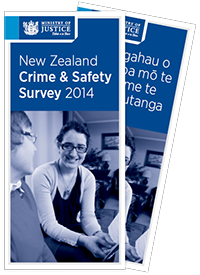
Information pamphlet
The information pamphlet explained:
what the NZCASS is and why we do it
what the information collected is used for
what type of questions are asked
who does the NZCASS and when they will do it
who will be asked to take part
0800 numbers for both Reach Aotearoa (formerly CBG Health Research - the company doing the survey for the Ministry of Justice) and the Ministry of Justice, in case respondents wanted to confirm the validity of the research or talk to someone about it.
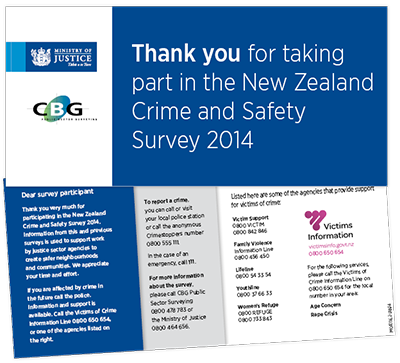
Thank-you card
Interviewers offered respondents a thank-you card at the end of the interview. This card had contact details for a range of support organisations that could help victims of crime.
A number of processes supported interviewers through the fieldwork process and helped them complete interviews on time and to the required standard.
The field management team monitored interviewers during fieldwork. They regularly examined individual interviewer’s survey completion rates and data quality to make sure all interviewing was done on time and to the required quality.
Interviewers had weekly teleconference meetings where the survey management team told them the key messages and shared useful information. Throughout the survey, interviewers got extra training or support if it was identified that they needed it.
The fieldwork provider set up an online dashboard so the Ministry of Justice could see fieldwork statistics in real time. The provider also delivered formal monthly fieldwork reports to the ministry that summarised their progress.
As part of NZCASS fieldwork, interviewers may have encountered distressing or high-risk situations. Maintaining respondents’ confidentiality is a critical part of the interviewer’s role but they had to balance this with the need to make sure everyone was kept safe.
Role of the interviewer
The interviewer’s role is to collect survey data and to protect the confidentiality of that data and the privacy of people providing the data.
Given the nature of the NZCASS and the questions asked, interviewers were likely to hear about a range of serious offences that had been committed against respondents; however, the role of the interviewer was not to:
provide support or help to respondents
report incidents for respondents.
Interviewers offered the ‘thank-you card’ to all respondents at the end of the interview so they could get help from a range of suitable organisations, if they wanted to. Interviewers were trained to strongly encourage respondents to contact either the Police or one of the organisations listed, if they needed to report an incident or seek help.
Exceptional circumstances
During NZCASS fieldwork, interviewers may have faced exceptional circumstances.
An ‘exceptional circumstance’ is defined as a serious and imminent threat to the interviewer’s safety, the life of the respondent, a member of the respondent’s household or to public safety.
Interviewers used a protocol to assess and escalate any exceptional circumstances during fieldwork.