Scam texts and emails relating to fines continue to circulate. We do not send payment links in our texts or emails. If you get a message about a fine and are unsure whether it is genuine, please contact our call centre on 0800 4 FINES (0800 434 637) before clicking links or making any payment. Read more about identifying scams.
In the New Zealand Crime and Safety Survey (NZCASS), we look at the data across a range of social, demographic and geographic factors to help understand who is more or less likely to behave in different ways or be victimised.
We have summarised and discussed the significant factors in the NZCASS Main findings report, and you can find a range of detailed factor tables in the NZCASS data tables. The information on this page aims to help readers correctly interpret these factor tables.
Before you can interpret the factor tables correctly, you need to understand the factors these tables relate to.
Personal factors
Personal factors include sex, age, ethnicity, legally registered relationship status and partnership status.
Partnership status says whether a person had a partner (or not) at the time of the interview. Partnership status is then broken down into whether the person was in a legally registered partnership (a marriage or civil union) or a non-legally registered partnership (such as a de facto or boyfriend/girlfriend relationship).
When looking at these factors, note the relationship between them. For example, a person may have a ‘legally registered relationship status’ of ‘separated/dissolved (divorced)’ and be in a non-legally registered relationship at the same time – this means they could be separated from their husband or wife and in a new relationship with their boyfriend or girlfriend.
Household factors
Household factors include who makes up the household (household composition), how long they’ve lived there (tenure) and landlord type.
Household composition is based on Statistics NZ’s standard classifications. The question asked in the NZCASS is: 'Which of the following people live in the same household as you?'
Composition grouping
Description
One-person household
Lives alone.
One parent with child(ren)
One person living with their son(s) and/or daughter(s) (natural, step, adopted or foster).
One parent with child(ren) and other person(s)
This household could include another person that is unrelated, such as a flatmate or boarder or could be related but not part of the immediate family unit, such as parent’s sibling/children’s aunt.
Couple only
Two persons who are either opposite-sex or same-sex spouses / civil union partners / partners.
Couple with no children and other person(s)
This household could include another person, such as a flatmate, boarder or a family member, such as a parent of one couple member.
Couple with children
Two persons who are either opposite-sex or same-sex spouses / civil union partners / partners, living with their son(s) and/or daughter(s) (natural, step, adopted or foster).
Couple with children and other person(s)
This household could include another person that is unrelated, such as a flatmate or boarder or could be related but not part of the immediate family unit, such as parent’s sibling/children’s aunt.
Multiple family household
This is when multiple families are living in the same household for example. two married couples flatting together or a married couple plus one partner’s mother and father (which is considered a second family unit).
Other multi-person household
This comprises of households of related and / or unrelated people, where there is no couples, or parents with a child. It consists for example of flatting arrangements, two siblings living together or one person with a boarder.
Note: The terminology of 'children' can relate to young children or adult children, but are defined to be children if they do not have their own partners nor children of their own living in the household.
Economic factors
Economic factors include employment status, financial stress, NZ Deprivation Index, personal and household income.
Employment status was updated in 2014 to better reflect Statistics NZ standards and more clearly identify groups that are not in the labour force (which is those people who are not employed but do not identify as ‘unemployed’).
Financial stress questions were added to the NZCASS in 2014 to measure two aspects of financial hardship:
limitation around buying a non-essential item worth $300
limitation around meeting a necessary but unexpected expense of $500.
The NZ Deprivation Index gives the level of deprivation in the area where the household is located (how rich or poor the neighbourhood is). This index is based on the latest census data available.
Geographic factors
Geographic factors include urbanisation and region.
Note: The NZCASS sample is not geographically stratified to ensure respondents are representative of each area in New Zealand. This means that NZCASS results are only analysed by wider regions and levels of urbanisation, and not by local area.
Urbanisation provides information by main urban area, secondary urban area, minor urban area, and rural. These groupings are in line with Statistics New Zealand standards. They differ from those reported on in 2009.
Region provides information for Auckland, Wellington, rest of North Island, Canterbury, and rest of South Island. These groupings were changed from 2009 to better align with standard classifications where possible. Due to sample sizes not all regional classifications were possible, but the 2014 groupings used are in line with the Household Economic Survey (HES).
Offence factors
Offence factors include perceived seriousness (of the incident), the victim’s definition of the incident and the victim’s relationship to the offender.
Perceived seriousness is from a question that asks the victim how serious they thought the incident was on a scale of 1 to 20, where ‘1’ indicates a very minor incident like theft of a newspaper from the gate and 20 indicates the most serious crime, murder. The scale has been grouped in the same way as previous years.
The victim’s definition of the incident says whether a person thought the incident was a crime or not. All incidents counted were legally coded as offences/crimes.
The victim’s relationship to the offender is a new factor. It has been defined and grouped according to the new NZCASS interpersonal violence reporting framework.
Each factor within these tables is tested for statistical significance against the New Zealand average. This lets us see which types of people are more or less likely to behave in a particular way or be more at risk of victimisation etc.
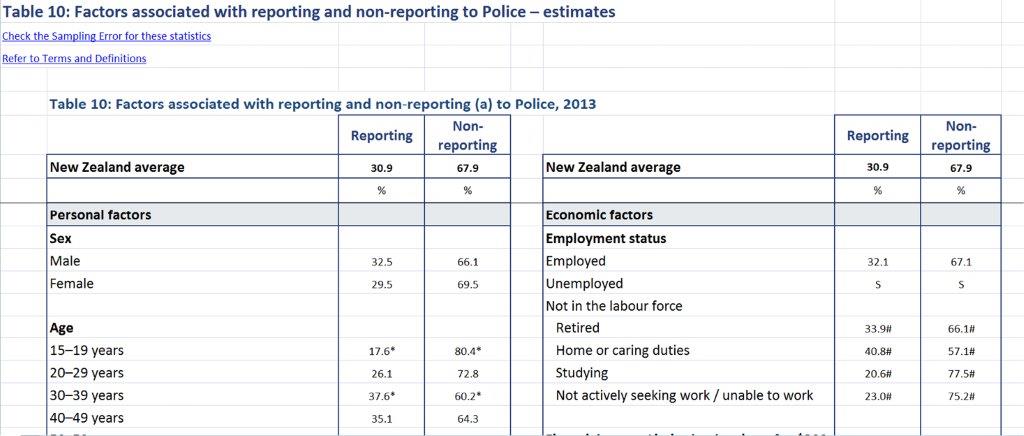
For example, in table 10 ‘Factors associated with reporting and non-reporting to Police’, a number of factors have an asterisk (*) beside them. This asterisk indicates a statistically significant difference from the New Zealand average.
EXAMPLE 1 – Saying it in a sentence: Personal factors
On average, 30.9% of incidents in 2013 were reported to Police. The incidents most likely to be reported to Police in 2013 involved victims:
aged 30–39 years (37.6%): 6.7% higher than the New Zealand average
who were separated or divorced (44.3%): 13.4% higher than the New Zealand average.
EXAMPLE 2 – Saying it in a sentence: Economic factors
On average, 30.9% of incidents in 2013 were reported to Police. The incidents least likely to be reported to Police in 2013 involved victims living in quintile 1 (the least deprived) areas of New Zealand (21.6%): 9.3% lower than the New Zealand average.
EXAMPLE 3 – Saying it in a sentence: Offence and impact on the victim factors
On average, 67.9% of incidents in 2013 were not reported to Police. The incidents most likely to go unreported to Police in 2013 were those:
perceived as being less serious (83.9%): 16% higher than average
where the victim defined the incident as ‘wrong, but not a crime’ (83.8%): 15.9% higher than average
where the victim defined the incident as ‘just something that happens’ (89.6%): 21.7% higher than average
where the offender was an intimate partner (75.9%): 8.0% higher than average
where no injury was sustained (87.6%): 19.7% higher than average
where the victim was affected ‘just a little’ (77.1%): 9.2% higher than average
where the victim was affected ‘not at all’ (84.1%): 16.2% higher than average.